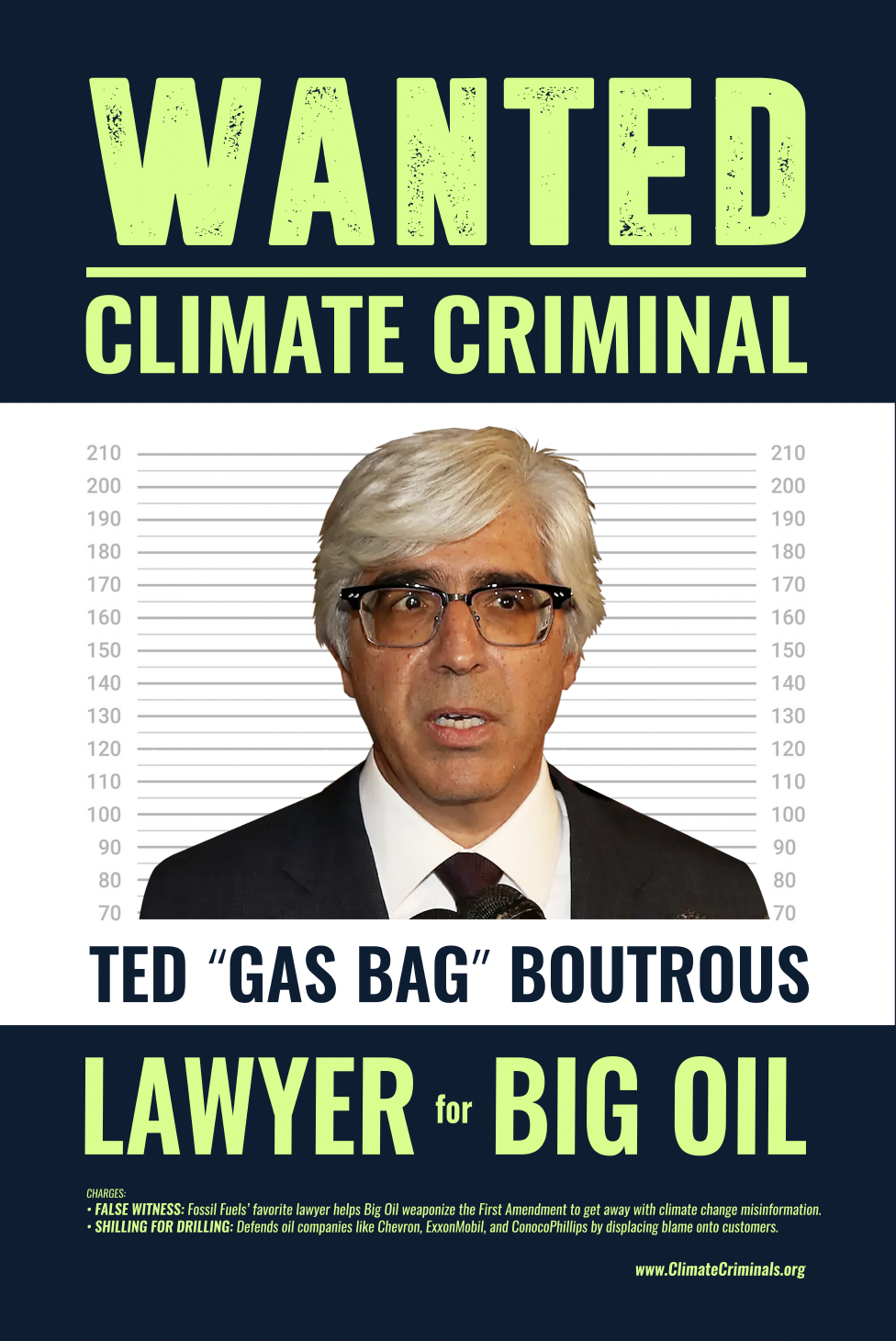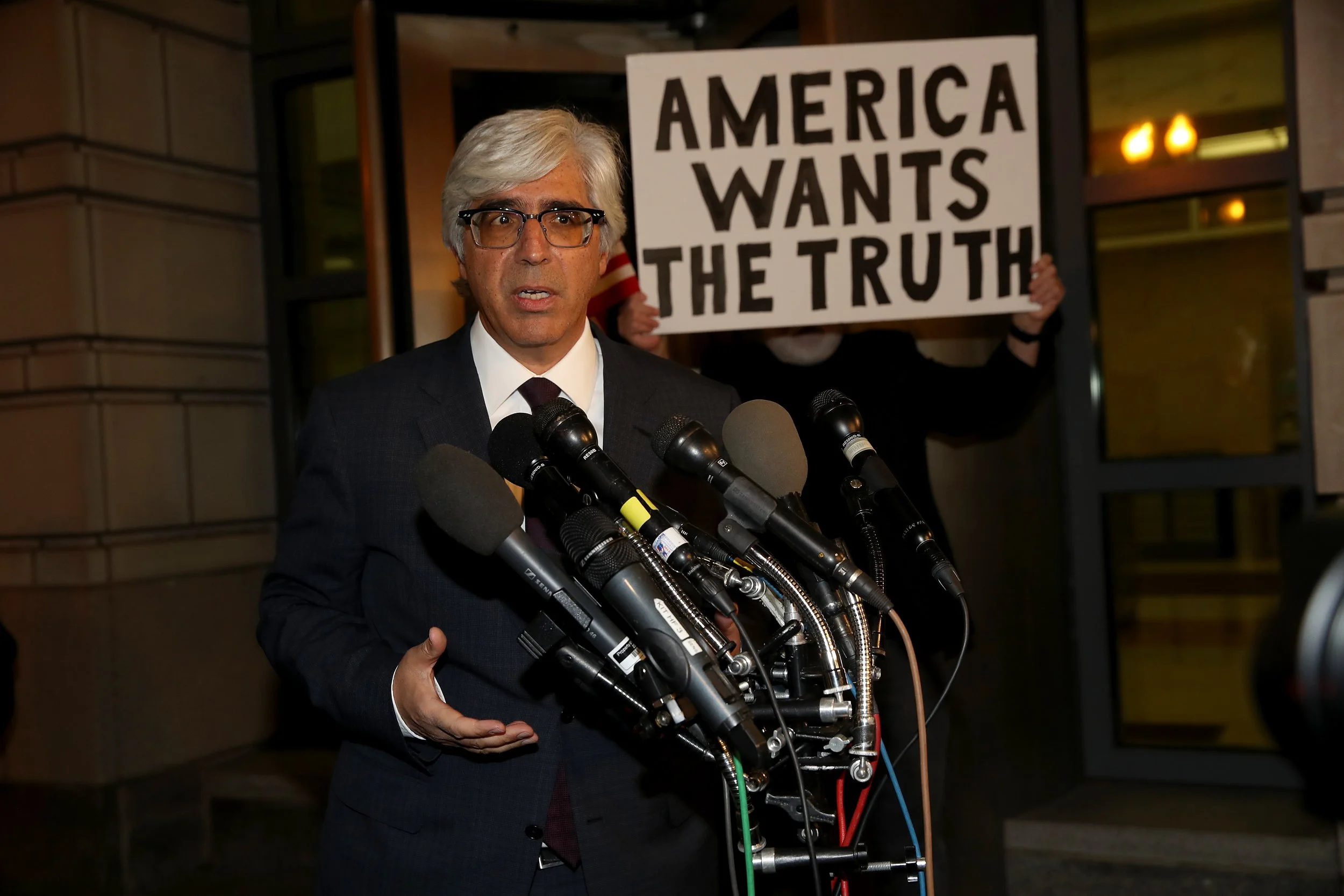
Ted boutrous
Partner at gibson dunn
Ted Boutrous is a partner at the law firm Gibson, Dunn & Crutcher, a firm dubbed “fossil fuels’ favorite law firm.” The firm has represented fossil fuel companies on many occasions, with Boutrous acting as the leading lawyer on over two dozen cases. Some of these companies include the American Petroleum Institute, Energy Transfer, ConocoPhillips, Chevron, ExxonMobil, and BP. Boutrous has benefited enormously from his work with fossil fuel companies, earning a high salary and numerous awards, including being listed in 2022 as one of the Top 100 Lawyers in California for the 18th year in a row. Ted Boutrous’s complicity in supporting the fossil fuel industry’s crimes against the people and the planet has earned him a spot on our list of climate criminals.
-
Birthday: September 23, 1960
Hometown: Bismarck, North Dakota
Primary residence: Indian Wells, CA
Current role: Partner at Gibson, Dunn & Crutcher Law Firm
Net worth: Unknown
Compensation salary: At least $6M
Education:
JD from the University of San Diego School of Law (1987)
BA from Arizona State University (1984)
Board memberships, affiliations, and roles:
Council member of the International Women’s Media Foundation (IWMF)
Director of the California Supreme Court Historical Society
Member of the Business Advisory Council of ProPublica
Fellow of the American Academy of Appellate Lawyers
Member of the Reporters Committee for Freedom of the Press
Member of the Product Liability Advisory Council
Member of the American Law Institute
Admissions:
Solicitor, registered foreign lawyer in England & Wales
Past roles:
Joined Gibson Dunn Law Firm in 1987
Editor-in-Chief of the San Diego Law Review (1987)
Fun facts:
Ted Boutrous was Brad Pitt’s lawyer during his custody battle with Angelina Jolie.
The Guardian nicknamed Boutrous “The Smooth Talker” in 2021 on their “Dirty Dozen” list.
Boutrous is very active on his X account and has 58.8K followers.
-
Representing Fossil Fuel Companies:
Ted Boutrous has represented numerous fossil fuel companies, including the oil giant Chevron, (the second-largest emitter of greenhouse gasses of any company in the world in 2019). Boutrous has profited from defending the wealthy and powerful in cases that some criticize are “at the expense of disempowered people and communities.”
Defending Climate Misinformation:
Many states and localities are suing Chevron and other fossil fuel companies in tort suits, seeking to hold them liable for climate damages, denial of risks to shareholders, and disinformation in the public realm.
GDC is representing Chevron, BP, and many other large oil companies in many of these cases, providing armies of lawyers to help evade accountability for the fossil fuel companies. Named as defendants in each of these suits, the four most prominent “oil majors” in the U.S. (ExxonMobil, Chevron, Shell, and BP) each understood that fossil fuels pose a global threat by creating unnatural climate change. They all participated in financing opposition to climate policy solutions and also attacks on the science itself.
DeSmog and ExxonKnews co-published an article in January 2024 that explains how Gibson, Dunn & Crutcher has played both sides of free speech, both using it to defend Big Oil’s misinformation and silencing critics of the fossil fuel industry.
Gibson Dunn has defended Chevron and other companies’ statements about climate change as First Amendment-protected “political speech” because they concern public opinion and policy.
Silencing Protestors:
While Gibson Dunn has worked to expand free speech rights for corporations, it has done the opposite for some individuals. In July 2023, Gibson Dunn began representing Energy Transfer in a case filed in North Dakota against Greenpeace USA and protesters of the Dakota Access Pipeline on the Standing Rock Sioux Indian Reservation. Originally filed by Kasowitz, Benson & Torres in 2017, this suit was escalated by Gibson Dunn, which charged protestors with violating state and federal Racketeer Influenced and Corrupt Organization (RICO) laws, potentially holding the protestors responsible for almost $1 billion in damages.
Gibson Dunn previously helped Energy Transfer’s subsidiary, Dakota Access LLC, defend the pipeline’s continued construction against other legal challenges by tribal leadership.
According to Deepa Padmanabha, legal counsel for Greenpeace US, “The thought is that if they can successfully silence an organization like Greenpeace US, that will have a ripple effect and smaller groups and individuals won't dare speak out. The precedent that the fossil fuel industry is trying to set around protest and protest liability is so dangerous that, if successful, it is difficult to envision how this won’t have a chilling effect.”
Chevron v. Ecuador:
Between 1964 and 1990, Texaco, later acquired by Chevron in 2001, had significant oil drilling operations in the Ecuadorian Amazon. Ecuadorians and their legal representatives allege that during this time, Texaco dumped more than 17 million gallons of crude oil, 16 million gallons of toxic wastewater, and additional miscellaneous hazardous waste into the Amazon Rainforest. In 2011, a landmark judgment was reached, ordering Chevron to pay $18 billion to fix environmental and punitive damage, but was later reduced to $9 billion by Ecuador’s Supreme Court after Chevron appealed. Chevron, represented by Ted Boutrous, refused to accept this judgment.
Through Boutrous, Chevron filed a lawsuit under the RICO Act, claiming that the plaintiffs had used means of massive fraud to unlawfully extort Chevron. This lawsuit named almost every lawyer, scientific consultant, activist organization, and named Ecuadorian as conspirators. Chevron, with essentially unlimited financial resources, was able to shop for a heavily biased judge: Lewis A. Kaplan. Their key witness has admitted to lying under oath after extensive preparation by Chevron’s legal team and was paid more than $2 million for providing false testimony.
Despite overwhelming evidence of Chevron’s wrongdoings, the judge presiding over the case ruled in Chevron’s favor and found Stephen Donziger to be in contempt of court for refusing to hand over electronic devices to Chevron’s legal team. Kaplan then appointed a private prosecutor to pursue criminal charges for contempt of court as well as choosing the judge to preside over the case instead of using random assignment. This judge, Loretta Preska, had held a position on the advisory board of the Federalist Society, to which Chevron had made significant donations in years past. Donziger was placed under house arrest in 2019 and remained there for the two years it took to go to trial. In July 2021 Judge Preska found Donziger guilty of six counts of criminal contempt of court, sentencing him to a maximum of six months in prison. He served just over a month in federal prison before returning to house arrest, where he was released in April of 2022.
Defending the Dakota Access Pipeline:
Gibson Dunn has been the primary firm representing the Dakota Access Pipeline (DAPL) in litigation. Gibson Dunn has fought against Tribes in court for years, despite mass protests by Native activists who were attacked by dogs and water cannons, and the knowledge that the pipeline transports 500,000 barrels of oil a day and threatens Tribes’ water supply.
Even though the pipeline was improperly authorized, Gibson Dunn has continued to facilitate the continuation of its construction and operations. Additionally, despite a court ruling that the Army Corps of Engineers failed to adequately consider the risk of oil spills when conducting its environmental review, DAPL is still operating.
-
Wealth and Praise:
Boutrous has a net worth of at least $6.5M, with one report alleging that he billed clients $1,525 per hour in 2020 and another saying that he bills $2,000 an hour.
Boutrous’s successes in the courts have caused “even progressive organizations, foundations, and investigative reporting groups” to praise his promotion of “free speech” and “free press.”
Recognition:
In 2022, Boutrous was listed as one of the Top 100 Lawyers in California by The Daily Journal for the 18th year in a row.
In 2021, Los Angeles and San Francisco Daily Journals named him a “Top Lawyer of the Decade.”
Boutrous also won the “Freedom of the Press Award” in 2021, which was awarded by the Reporters Committee for the Freedom of the Press, of which Boutrous is a member.
Chevron was listed as one of the “Legacy Champion” sponsors that same year, reportedly giving the Reporters Committee at least $50,000.
Boutrous was awarded multiple honors in 2019, including Litigator of the Year in 2019 by The American Lawyer due to his number of high-profile cases, First Amendment Award by the Hugh M. Hefner Foundation, and the Distinguished Leadership Award from PEN America.
Philanthropic Activity:
Undisclosed amount to the ACLU of Hawaii in 2010
Over $1,000 to Boys and Girls Clubs of America in 2003 and over $10,000 in 2006
Undisclosed amount to the California Bar Foundation (of which Boutrous is a member) in 2010
Over $1,000 to the International Women's Media Foundation (of which Boutrous is a council member) in 2009 and 2012
Over $1,000 to the Jewish Free Loan Association
Over $5,000 to Mount St. Mary's College in 2014
Over $1,000 to the Nuclear Age Peace Foundation in 2009
Over $5,000 to the University of San Diego in 2004
Over $1,000 to Vision to Learn in 2016
-
Gibson, Dunn & Crutcher is a prominent law firm with a significant role in the overall architecture of carbon capital. Within the fossil fuel commodity chain, the firm primarily provides legal counsel and support for various financial transactions related to fossil fuel projects. The firm has represented: American Petroleum Institute, Energy Transfer, ConocoPhillips, Chevron, ExxonMobil, BP, and many other companies.
Gibson Dunn assists in structuring financing deals, mergers and acquisitions, project development, and regulatory compliance for companies involved in extracting, producing, and transporting fossil fuels. While Gibson, Dunn & Crutcher may not be a big emitter directly, their clients in the fossil fuel industry are; as such, they may advise these clients on compliance with emissions regulations and reporting requirements.
Law firms are still in “the early days of being required to report energy and carbon usage in their annual accounts”. Measures of capturing, assessing, and reporting this data vary greatly from firm to firm, making it challenging for people to find specific reports on Gibson, Dunn & Crutcher’s carbon emissions.
-
Law Students for Climate Accountability wrote a letter to Gibson Dunn, calling on the law firm to commit to a public ethical standard that articulates what fossil fuel work is incompatible with their commitments to the climate & frontline communities.
This effort was part of the #DoneWithDunn campaign to boycott the law firm due to its efforts to shield “corporate polluters from climate accountability.” Additionally, Law Students for Climate Accountability listed the firm as “having the second highest amount of fossil fuel litigation work of all 26 firms the group evaluated”, and gave it a score of F.
In 2021, The Guardian listed Ted Boutrous on their Dirty Dozen list of “America’s top climate villains” for his involvement in being the “main spokesman for all the oil companies in some two dozen climate liability cases.”
-
“You see the Biden administration, the secretary of state, calling for energy production to protect our country. So, I think, when you look at the doctrines we're relying on, the extraordinary nature of these cases, it really is a play for private lawyers, funded by various foundations and the like, working with municipalities and states to seize control of federal energy policy and to change how we consume energy.” –Boutrous, 2024
“These wasteful lawsuits in state courts will do nothing to advance global climate solutions, nothing to reduce emissions and nothing to address climate-related impacts” – Boutrous talking about state & local governments pursuing litigation against oil companies seeking climate-related damages in April 2023
“Freedom of speech does not mean making knowingly obviously dangerously false statements of fact.” –Boutrous, 2022
“My supporting Democratic candidates and Democratic officeholders is completely consistent with my view that climate change is an extraordinarily important global policy issue. It must be dealt with by Congress, by the executive branch, by international bodies, it’s not something that can be dealt with through tort litigation.” –Boutrous, 2021
“Chevron is a great company and great client with a strong culture of social responsibility.” –Boutrous, 2021
“Chevron accepts what the IPCC has reached consensus on concerning science and climate change”; “It’s a global issue that requires global action”; “IPCC doesn’t say that the extraction or production of fossil fuels leads to emissions. Its energy use, the economic activity, that drives the demand for fuel that leads to emissions.” –Boutrous, 2018
Connections within the Polluter Industrial Complex
-
Boutrous’s Political Donations:
Boutrous has given more than $132,000 to Democratic candidates and PACs in the last five years
$2,500 to Amy McGrath (D)
Fought to unseat Senate Minority Leader Mitch McConnell (R)
$10,000 to Beto O’Rourke (D)
Even though O’Rourke signed a No Fossil Fuel Money pledge, he was removed from the pledge as he raised money in individual donations (including executives) from people who work in the oil and gas industry ($476,325)
He was the second-largest recipient of oil and gas money in the US in 2018, after Ted Cruz
Cruz’s lifetime environmental score: 3%
Other Donations (≥$5,000)
Gibson, Dunn & Crutcher Political Donations:
Top recipients in 2024:
Other:
Gibson, Dunn & Crutcher Political Connections:
Revolving Door Project and the People’s Parity Project revealed that, of the partners currently working at Gibson Dunn, at least 30 have had executive branch experience from either the Obama or Trump administrations.
Positions previously held by these partners include: the Department of Justice, the Federal Trade Commission, and the White House
Ties to the Republican Party
President Ronald Reagan’s Attorney General William French Smith was a Gibson Dunn partner
Partner Ted Olson holds a seat on the Board of Trustees at the Reagan Foundation
Olson also served as solicitor general in the George W. Bush administration and represented Bush in the Bush v. Gore Supreme Court case
Trump EPA general counsel who helped weaken the Clean Waters Act narrowing the government’s authority in the Navigable Waters Protection Rule was former Gibson Dunn partner David Fatouhi
-
Gibson, Dunn & Crutcher Lobbying Activity
2023 Lobbying Total: $460,000
Firms that hired Gibson, Dunn, & Crutcher
Lobbyist Michael Bopp formerly worked on congressional committees and for Senator Susan M. Collins from 1999-2003
Lobbyist Roscoe Jr Jones formerly worked for the US Department of Justice, Senate, and House of Representatives
In 2023, Binance pleaded guilty to anti-money laundering and sanctions charges to resolve a long-running investigation by prosecutors and regulators. Binance admitted that it allowed transactions with Hamas and other terrorist groups on the exchange
Current CEO and Chairman Bruce Selkirk previously founded and served as president/CEO of Crossing Rocks Energy, a company that acquires, develops, and monetizes North American oil and gas
Nonprofit lobbyist association; members are chief executive officers of major US companies. Unlike the US Chamber of Commerce, whose members are entire businesses, BRT members are exclusively CEOs.
Chairman of the board is Mike Roman, the CEO of 3M, a $35 billion science and manufacturing company. 3M has faced thousands of lawsuits for the last two decades over its manufacturing of products containing controversial chemicals that also contaminated US drinking water systems
Lobbied to influence the federal government not to pass the NOPEC act. The act (No Oil Producing and Exporting Cartels) would restrict the export of oil from Saudi Arabia by removing the state immunity shield. It would allow the international oil cartel (OPEC) to be sued under U.S. antitrust law for anti-competitive attempts to limit the world’s supply of petroleum and subsequently raise oil prices
Gibson, Dunn & Crutcher represented the oil conglomerate in their efforts to lobby House Republicans on tax reform in 2017 for $100,000
Gibson, Dunn & Crutcher represented the Mining company in 2022 for $30,000
-
Law Students for Climate Accountability:
Gibson, Dunn, & Crutcher was given an F on Law Students for Climate Accountability’s 2023 Climate Accountability Scorecard. Gibson, Dunn & Crutcher was rated among the worst of the worst, with the second-highest amount of fossil fuel litigation work of all 26 firms evaluated.
Exxon Mobil Corp. v City of Hoboken:
This case sought to hold oil and gas companies accountable for their role in climate change. The City of Hoboken alleged that oil and gas companies engaged in a decades-long campaign to downplay the effect of fossil fuel usage on climate change. Boutrous Defended Exxon.
BP v Mayor and City Council:
Boutrous defended BP against the Mayor and City Council of Baltimore, who sued energy companies in Maryland state court, seeking to hold them liable for harms attributable to global climate change.
County of San Mateo v Chevron Corp (2017):
36 of the largest oil companies were targeted, specifically noting the possibility of water inundating roads, sewage treatment plants, and other real estate. Ted Boutrous, with Gibson, Dunn, & Crutcher, represented Chevron.
Koch Industries:
Lobbied on the House Republicans Blueprint on Tax Reform in the US Senate and the House of Representatives in 2017
Koch Family Foundations have spent $145,555,197 directly financing 90 groups that have attacked climate change science and policy solutions, from 1997-2018.
Other cases:
Successfully represented Walmart before the Supreme Court in the 2011 Dukes case, which reversed what had been the largest employment class action in history and established important standards governing class actions
In 2018, Boutrous successfully represented CNN and its reporter Jim Acosta in bringing the First Amendment and due process claims against then-President Donald Trump and other White House officials, forcing them to restore Mr. Acosta’s press credentials
In 2021 he secured a victory for Hewlett-Packard Company when the California Court of Appeal affirmed a more than $3 billion verdict in HP’s contract dispute with Oracle Corp.
Citizens United v Federal Election Commission:
On January 21, 2010, the U.S. Supreme Court issued a decision that portions of the McCain-Feingold campaign finance law banning corporate and union expenditures on political speech violate the First Amendment. In its 5-4 decision, the Court held that the government cannot prohibit corporations and labor unions from funding political speech
The Citizens United decision has dramatically reshaped the political landscape by opening the floodgates to unlimited money from special interest groups into the election system, enabling corporations and other wealthy donors to have vastly more influence over our political system than the average American.
This case also paved the way for Super PACs that can accept unlimited contributions from donors, including corporations, as well as dark money spending often by certain non-profit organizations that are not required to disclose their donors.
According to a report issued by Connor Gibson, in the decade that followed the Citizens United ruling, the Center for Responsive Politics found that “dark money” political spending totaled almost a billion dollars. The report further notes that the Brennan Center for Justice reported that the ruling’s impact “exacerbated trends of racial bias, wealth inequality, and foreign influence in politics”
-
Gibson, Dunn & Crutcher Foundation:
Supports museums and organizations involved with performing arts, domestic violence, child welfare, diseases, legal aid, youth development, children’s rights, human services, and Judaism. The firm’s lawyers are also involved in hundreds of nonprofit organizations across the globe through board service, pro bono work, and financial contributions. Some of these include:
Partner Brad Roach has been a director of the Association of International Energy (formerly Petroleum) Negotiators. It is an independent not-for-profit membership association that supports international energy negotiators around the world.
Produces a range of model contracts for oil & gas projects
Partner William Kilberg is a member of the board of the Executive Roundtable of the Republican Governors Association, an organization consisting of U.S. state Republican Governors with an objective to help elect and support Republican governors.
Other Executive Committee members include big oil & gas supporters such as Greg Abbott (TX), Henry McMaster (SC), and Greg Gianforte (MT)
-
One of Gibson Dunn’s partners and lobbyists, Roscoe Jones Jr., is a member of the Council on Foreign Relations
-
Gibson, Dunn, & Crutcher has its own trade group called Gibson Dunn’s International Trade group, which was named by Law360 as its 2012 International Trade Group of the Year.
Although they aren’t listed, Gibson, Dunn, & Crutcher’s clients allegedly include trade associations.
-
Ted Boutrous got his BS from Arizona State University in 1984.
Boutrous obtained his law degree at the University of San Diego School of Law in 1987. At USD School of Law, Boutrous graduated summa cum laude and was Valedictorian. Boutrous was also the Editor-in-Chief of the San Diego Law Review. Boutrous donated more than $5,000 to the University of San Diego in 2004. Boutrous was the keynote speaker for the 2020 Class Action Law Forum, which was presented by Western Bank Settlement Services and USD’s School of Law.
Ted Boutrous’ wife, Dr. Helen Boutrous, is a professor and the Chair of the History and Political Science Department at Mount St. Mary’s College. Dr. Boutrous has donated at least $10,100 to Mount Saint Mary’s College between 2004-2014. Ted Boutrous also donated to Mount Saint Mary’s College, donating over $5,000 in 2014.
-
Standard Fire Insurance Co.
In 2013 Boutrous successfully represented the prevailing party in obtaining a unanimous Supreme Court decision enforcing the Class Action Fairness Act (Standard Fire Insurance Co. v. Knowles)