
-
Birthday: August 13, 1938
Hometown: Watertown, SD
Primary residence: Dallas, TX
Current role: Honorary Trustee at the Mayo Clinic (2006 - present)
Net worth/salary: Wealth of at least $670M, according to WealthX (September 2025)
Education:
BA in chemical engineering from University of Wisconsin-Madison (1960)
PhD in chemical engineering from University of Minnesota (1963)
Honorary Doctor of Laws from University of Minnesota (2011)
Board memberships, affiliations, and roles:
Advisor at Kohlberg Kravis Roberts & Co (2008 - present)
Member of American Council on Germany
Member of the National Academy of Engineering
Member of Emergency Committee for American Trade
Advisory board member of Decision Sciences
Member of President’s Export Council
Member of US-ASEAN Business Council
Member of Business Roundtable
Trustee of John F. Kennedy Center for the Performing Arts
Council Member of The University of Texas Southwestern Medical Center
Vice Chairman of Kennedy Center Corporate Fund
Member of University of Wisconsin Foundation
Member of Singapore-US Business Council
Member of University of Wisconsin Foundation
Member of Augusta National Golf Club
Vice Chairman of American Enterprise Institute
Past roles:
CEO & chairman of ExxonMobil from 1999-2005
CEO of Exxon since 1993
Joined Exxon in 1963 (whole career was at Exxon)
President from 1987
Director from 1984
Director at JP Morgan Chase & Co (1987-2020)
President of Esso Inter America (1983-1984)
Chairman of API (1996-1997; 2001)
Trustee of the the American Enterprise Institute
Member of the Council on Foreign Relations
Emeritus Trustee of the Mayo Clinic
Member & past Chairman of the National Petroleum Council
Advisory board member of US Department of Energy
Member of Trilateral Commission
Executive of Creole Petroleum
Director of United Way Worldwide
Trustee of Southern Methodist University
Director of Business Council for International Understanding
Director of New American Schools Development Corporation
Director of United Negro College Fund
Trustee of Wisconsin Alumni Research Foundation
-
Climate Denialism
During his time at ExxonMobil, Lee Raymond funded numerous climate denial organizations. From 1997 to 2005, ExxonMobil donated roughly $19.5M in grants to climate denial organizations. Many of these organizations are members of the Cooler Heads Coalition (CHC), a coalition that has described itself as an “informal and ad-hoc group focused on dispelling the myths of global warming.”
The Climate Investigations Center found that Raymond promoted Ken Cohen from Legal Counsel to VP for Public and Government Affairs at ExxonMobil. Ken Cohen, as described in a book by Steve Coll titled “Private Empire: ExxonMobil and American Power”, was found to oversee contributions to advocates against greenhouse gas reduction. Coll also described Raymond as “notoriously skeptical about climate change and disliked government interference at any level.”
In 1985, Lee Raymond and employees from the company’s Corporate Research Program were briefed on the “CO2 Greenhouse” effect. Despite being briefed on the matter, ExxonMobil has gone on to publish numerous climate-related ads over the years, the majority of which emphasize the “lack” of adequate evidence on the impact that greenhouse gas emissions have on climate change.
Timeline of Climate Denialism
In 1996, the American Petroleum Institute held an event where Lee Raymond spoke as chairman of the board. During his speech, Raymond discussed what he called “so-called global climate change”, saying that “... scientific evidence remains inconclusive as to whether human activities affect global climate.”
In October 1997, during the 15th World Petroleum Congress in Beijing, China, Lee Raymond’s 78 paragraph speech featured 33 paragraphs on the “illusion” of climate change and that cuts to CO2 weren’t needed.
“... Leaping to radically cut this tiny silver of the greenhouse pie on the premise that it will affect climate defies common sense and lacks foundation in our current understanding of the climate system.”
In June 1997, Raymond made a speech that argued that the debate of climate change has shadowed the most important thing, “the undeniable link between economic vitality and energy use.”
In 1998, ExxonMobil created the Global Climate Science Team (GCST). A memo for GSCT said “victory will be achieved when average citizens understand uncertainties in climate science”. In the same memo, it was proposed that Exxon and its PR firms should “develop and implement a national media relations program to inform the media about the uncertainties in climate science.”
In 2000, Raymond supported a petition that was signed by anti-IPCC scientists that claimed that there was no substantial or convincing scientific data regarding the role that greenhouse gases played in climate change. Regarding this petition, Raymond said “What I am saying is there is a substantial difference of view in the scientific community as to what exactly is going on…We’re not going to follow what is politically correct.”
In 2001, in regards to the Kyoto Protocol, Raymond argued that it is “...unworkable, unfair, ineffective and potentially damaging to other vital economic and national interests.”
In September, 2001, the IPCC met in London to work on the final draft of the Third Assessment Report on climate change. Following the meeting, ExxonMobil suggested that part of the report be amended to delete the text: “...with some of these changes attributable to human activities.”
In 2002, Lee Raymond announced that ExxonMobil plans to “stay the course” on their stance on climate change “until someone comes along with new information.”
In 2004, ExxonMobil placed an advertisement in the New York Times that said “Scientific uncertainties continue to limit our ability to make objective, quantitative determinations regarding the human role in recent climate change or the degree and consequences of future change.”
In 2005, Lee Raymond was interviewed by Charlie Rose. During the interview, Raymond held firm his climate skepticism, saying that “... the climate has changed every year for millions of years. If we weren’t here, the climate would change… now, the question is, is part of what’s happening related to something other than natural variability? And if so, how do you determine what that is? And the reality is, the science isn’t there to make that determination.”
Financing Climate Disinformation
Lee Raymond financed climate disinformation for years during his time at ExxonMobil. From 1997-2015, ExxonMobil donated over $11M to think tanks in the Cooler Heads Coalition, a coalition that has described itself as an “informal and ad-hoc group focused on dispelling the myths of global warming.”
To read more about Raymond’s history of financing climate disinformation, visit the “Think Tanks” section.
Delaying Climate Action
Under Lee Raymond’s leadership, ExxonMobil positioned itself as “an enemy of the planet” due to its failure to curb CO2 emissions.
Environmental Damage
According to Violation Tracker, ExxonMobil has had to pay a total of $3,366,660,466 in penalties since 2000, with $2,220,698,866 being environment-related offenses.
The Exxon Valdez Oil Spill
In 1989, Exxon’s oil tanker, Exxon Valdez, hit the Bligh Reef off the coast of Alaska and spilled millions of gallons into the Prince William Sound, impacting roughly 1,300 miles of shoreline. The oil tanker’s hull was split and poured 11,000,000 gallons of oil into the Sound, killing “thousands of animals and hundreds of birds.” Prior to the 2010 Deepwater Horizon oil spill, the Exxon Valdez spill was the largest and worst oil spill in the United States.
Despite efforts to clean up the Sound in the years following, it’s reported that the ecosystem of the Sound is still suffering from the impacts of the spill. In addition to impacting the ecosystem, the oil spill negatively impacted the livelihoods of Alaska landowners, Native Americans, and fishermen.
When asked by a lawyer for the state of Alaska if Exxon did anything wrong, Lee Raymond retorted that “well, I don’t mean to be argumentative, but assigning blame isn’t the same as being right or wrong.” In response to whether Exxon’s actions following the spill were wrong, Raymond stated that “the state may have a view on that and I have a different view.”
-
Historic Severance Package
Lee Raymond retired from his role as CEO at ExxonMobil in 2005, where he received a severance package totalling roughly $400M
Honors/Recognition
In 2006, Lee Raymond received the API Gold Medal for Distinguished Achievement, API’s highest honor.
In 2006, Raymond and his wife received the “Charles Cameron Sprague Community Service Award” from the Southwestern Medical Foundation.
Assets (WealthX)
$3.5M home in Dallas, TX
$2.5M home in Westlake, TX
$2.5M home in Scottsdale, AZ
$20,000 2015 Mercedes-Benz S Class
-
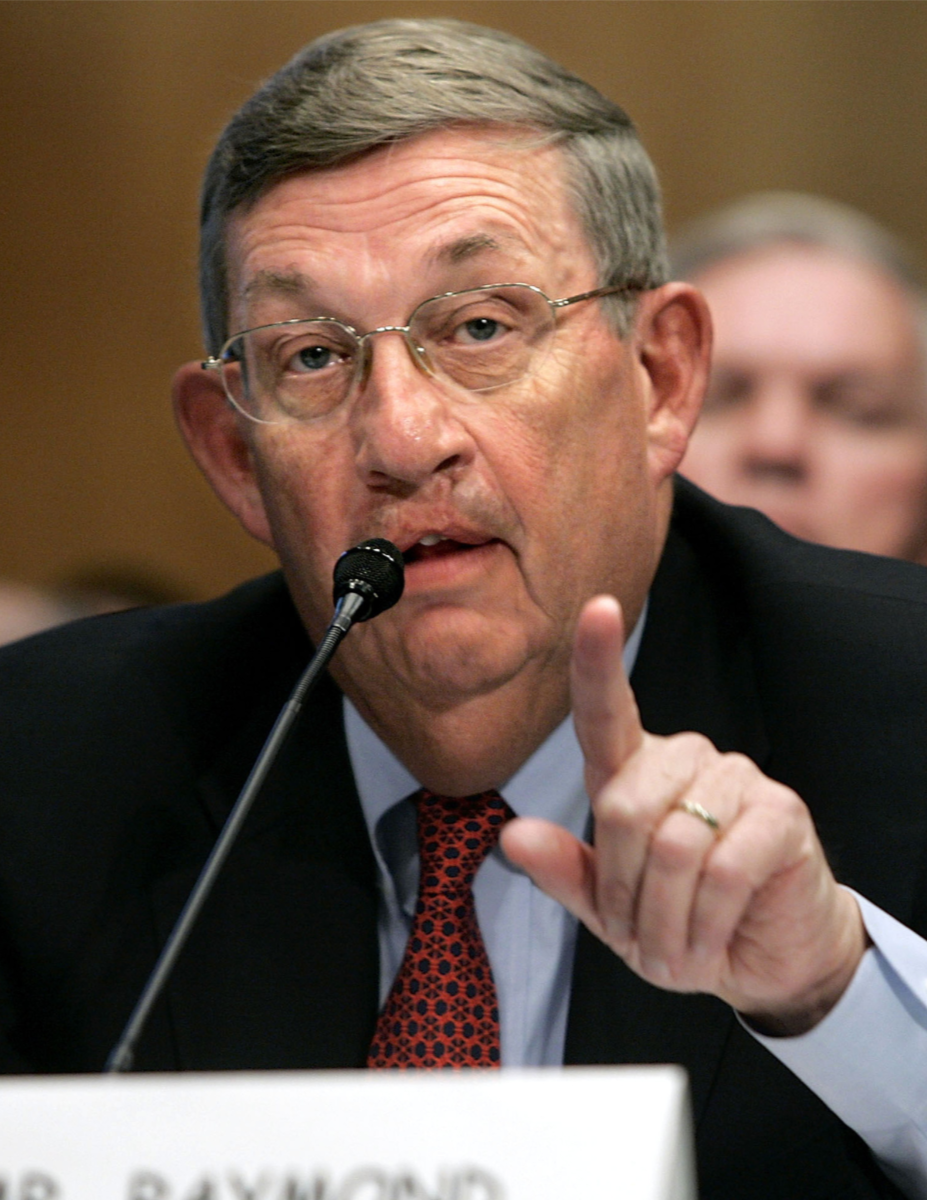
Lee Raymond is the former CEO and Chairman of ExxonMobil, the largest oil and gas company in the United States.
ExxonMobil first began publishing its emissions in 2003, two years before Lee Raymond’s last year at the company, and has since published annual sustainability reports.
InfluenceMap has reviewed ExxonMobil’s climate disclosure efforts and has given the company a low score.
Accuracy of Climate Policy Engagement Disclosure: Partial
Accuracy of Direct Climate Policy Engagement Disclosure: Partial
Accuracy of Indirect Climate Policy Engagement Disclosure: Partial
-
In 2000, environmental activists bought shares in ExxonMobil, allowing them to attend the corporation’s first annual meeting. During the meeting, activists shouted for climate action and a “long-term solution to global warming”, to which Raymond retorted that “there is no convincing evidence that any release of carbon dioxide, methane, or other greenhouse gases is causing or will in the foreseeable future cause catastrophic heating of the earth’s atmosphere and disruption of the earth’s climate.”
In 2003, environmental activists protested outside of ExxonMobil’s annual meeting.
Following the announcement of Raymond’s historic severance package, 100 protestors attended Exxon’s annual shareholder meeting in Texas. Protestors chanted and held signs saying “No planet, no dividends” and “pumping global warming lies.”
-
“Our analysis indicates that the current state of climate science is too uncertain to provide clear answers to many key questions about climate change. Even if global warming were a proven threat — which it is not — targets agreed on in Kyoto, Japan, fail to provide a fair, practical or cost-effective solutions” – Raymond in a 1998 ExxonMobil Pamphlet called “Global climate change: everyone’s debate”
“First, the world isn’t warming. Second, even if it were, oil and gas wouldn’t be the cause. Third, no one can predict the likely future temperature rise.” - Raymond in a 1997 speech at the World Petroleum Congress in Beijing, China
During a meeting at the Woodrow Wilson Center in 2004, Raymond stated that “the danger exists that economic activity will be compromised due to the efforts to meet the commitments that have been made. This is the fundamental reason that the developing world has been very cool to Kyoto.”
-
Government ties
It was reported that Donald Trump was considering Lee Raymond as his nominee for Secretary of State in 2016, but the nomination ultimately went to Raymond’s successor at ExxonMobil, Rex Tillerson.
$2,500 to Mitt Romney (R) in 2012
$7,500 to the Republican National Committee in 2012
$500 to Richard G Lugar (R) in 1992
$1,000 to Lloyd Bentsen (D) in 1991
$1,000 to Don Young (R) in 1990
ExxonMobil Lobbying in 2005 (Raymond’s last year at Exxon)
Total lobbying: $7,300,000
Hired firms:
Cloud & Co: $140,000
DCI Group: $140,000
Notable Lobbyist: Drew Cole
O’Connor & Hannan: $25,000
JPMorgan Chase & Co. Lobbying in 2020 (Raymond’s last year at JPMorgan)
Total lobbying: $2,890,000
Hired firms:
Rich Feuer Anderson: $200,000
Featured on Clean Creative’s F-List for lobbying for American Exploration and Production Counsel
S-3 Group: $200,000
Capitol Tax Partners: $200,000
theGROUP DC: $180,000
Notable lobbyist hired by JPMorgan Chase: Sudafi Henry lobbied for BP
Monument Advocacy: $120,000
Featured on Clean Creative’s F-List for lobbying for Shell
Lobbyists Kimberly Ellis, TA Hawks, and Andrew Howell lobbied for Royal Dutch Shell
Polaris Government Relations: $120,000
Avenue Solutions: $120,000
Fulcrum Public Affairs: $100,000
Cleary, Gottlieb et al: $10,000
Law firms
In 1989, Exxon’s oil tanker, Exxon Valdez, hit the Bligh Reef off the coast of Alaska and spilled millions of gallons into the Prince William Sound. Following the oil spill, Exxon paid millions in private claims and over $1B to settle laws violated under the Clean Water Act. Following the final suit, a district court in Alaska was awarded nearly $20M in damages against the fossil fuel giant and $5B in punitive damages. This suit was the largest lawsuit faced by Lee Raymond during his time at ExxonMobil.
Baker Botts LP
ExxonMobil has previously hired Baker Botts LP to represent them during a product liability trial in 2023. Baker Botts LP has received a score of F by the Law Students for Climate Accountability.
Insurance companies
In 2003, ExxonMobil reportedly bought “Directors and Officers Liability” insurance coverage from Ancon Insurance Company Inc. Ancon is a subsidiary of ExxonMobil and works for the Corporation’s worldwide affiliates.
Think tanks / think tank networks / policy institutes / research centers
Lee Roy Raymond’s Memberships (WealthX):
Member of American Council on Germany
American Enterprise Institute
Raymond is Vice Chairman
Member of the Council on Foreign Relations
Member of the Trilateral Commission
ExxonMobil’s Ties to Think Tanks
From 1997-2015, ExxonMobil donated over $11M to think tanks in the Cooler Heads Coalition, a coalition that has described itself as an “informal and ad-hoc group focused on dispelling the myths of global warming.”
Exxon’s donations to think tanks involved in climate skepticism and promoting fossil fuel interests:
Frontiers of Freedom: $1,272,000
In the organization’s mission statement, they described themselves as “the antithesis to the Sierra Club and Vice President Al Gore’s Earth in the Balance.”
The organization used to have a list of “Global Warming Papers”, which included articles written by numerous climate change skeptics.”
George C. Marshall Institute (now the CO2 Coalition): $865,000
The Institute shut down in 2015 and transferred its research to the Center for Strategic and International
American Legislative Exchange Council (ALEC): $1,880,700
In regards to climate change, ALEC has stated that “Global Climate Change is inevitable. Climate change is a historical phenomenon and the debate will continue on the significance of natural and anthropogenic contributions.”
Competitive Enterprise Institute (CEI): $2,100,000
According to CEI’s website, CEI’s Center for Energy and Environment “takes on all the hard energy and climate issues” and “questions global warming alarmism, makes the case for access to affordable energy, and opposes energy-rationing policies, including the Kyoto Protocol, cap-and-trade legislation, and EPA regulation of greenhouse gas emissions.”
Citizens for a Sound Economy (now Americans for Prosperity): $405,250
Citizens for a Sound Economy was created by the Koch Foundation
Committee for a Constructive Tomorrow (CFACT): $587,000
On climate change, CFACT stated that “Slightly higher atmospheric CO2 levels cannot possibly supplant numerous complex and inter-connected forces that have always determined Earth’s climate.”
Heartland Institute: $686,500
DeSmog has referred to the Heartland Institute as being “at the forefront of denying the scientific evidence for man-made climate change.”
According to the Union for Concerned Scientists, “nearly 40% of the funds that the Heartland Institute has received from ExxonMobil since 1998 were specifically designated for climate change projects.”
Fraser Institute: $120,000
The Fraser Institute stated that “the actual climate change in many locations has been relatively small and within the range of known natural variability. There is no compelling evidence that dangerous or unprecedented changes are underway.”
Trade groups / industry associations
Lee Raymond’s Memberships (WealthX)
American Petroleum Institute (API), the oil and gas industry’s largest trade association
InfluenceMap has given API a score of E- for their climate policy engagement
Emergency Committee for American Trade (ECAT)
US-ASEAN Business Council
Business Roundtable
InfluenceMap has given Business Roundtable a score of D for their climate policy engagement
Business Council for International Understanding (BCIU)
Private foundations
Lee Raymond’s Donations to Private Foundations (WealthX)
Children’s Aid - $15,000 in 2002
Children’s Medical Center - $1,000 in 2007
Council on Foreign Relations - $2,400+ from 1998-2020
United Negro College Fund - undisclosed amount from 1995-2003
United Way of Metropolitan Dallas - $20,000 from 1996-1999
Higher education related institutions
Lee Raymond’s Donations (WealthX)
Southern Methodist University Foundation for Research - $50,000 from 1996-2000
The Episcopal School of Dallas - $2,500+ from 2012-2019
Shelton School - $1,000+ in 2019
Shelthon School & Evaluation Center - $1,000+ in 2019
Astroturf organizations
ExxonMobil is a Member of the Western States Petroleum Association (WSPA), which is the oldest petroleum trade association in the country. Other members of the group include major fossil fuel companies like Chevron, BP, ConocoPhillips, Occidental Petroleum, and Shell.
Although not an astroturf organization itself, the Union of Concerned Scientists (UCS) has reported that WSPA has “many-well documented astroturf groups.” One such group includes the California Drivers Alliance, which claimed to represent the voices of consumers in California, but openly opposed Senate Bill 350 which advocated for a 50% decrease in petroleum use in the state and an increase in renewable energy. A former contributor for UCS claimed that the campaign against SB-350 was “one of the most extreme examples of fossil fuel-intestrest misinformation I’ve ever seen.”
During his 12 years as the CEO and Chairman from ExxonMobil, Lee Raymond facilitated in his company pumping roughly 6 billion tons of CO2 into the atmosphere and funneled at least $19M to climate denialism organizations. Lee Raymond’s long history of climate denialism makes him the perfect candidate for our lifetime Hall of Shame.